



Commercial lenders have spent years trying to reduce the time it takes to prepare borrower financials for analysis. Yet for many teams, document extraction remains one of the most manual and time-consuming parts of the credit workflow.
Borrowers send tax returns, financial statements, rent rolls, debt schedules, and supporting documents as PDFs. Analysts then review those files, locate key values, rekey the data into spreadsheets, standardize the financials, and validate the results before underwriting can begin. Even with OCR tools in place, much of that work often still requires manual review and cleanup.
That is because document extraction is not just about reading text from a page. In commercial lending, it is about turning borrower documents into usable financial data that can support spreading, underwriting, reporting, and monitoring. OCR provides the foundation for that process, and the industry is now exploring how additional automation can build on it.
This blog explores how document extraction has evolved, why OCR remains foundational to commercial lending, and how the industry is beginning to build on that foundation with AI to further automate financial data preparation for credit review.
Key Insights at a Glance
- Document extraction remains a major source of manual work in commercial lending
- OCR provides the foundation for modern document extraction workflows.
- Credit teams need more than text capture. They need usable, structured financial data
- The industry is exploring how AI can further organize, enrich, and prepare financial data for credit review.
- FlashSpread combines OCR and machine learning today, providing the foundation for AI-enabled workflows that further organize and prepare financial data for credit review.
Table of Contents
- Why Document Extraction Still Slows Credit Teams Down
- What OCR Does Well
- How Document Extraction Is Evolving
- From Text Extraction to Financial Data Preparation
- Why a Layered OCR + AI Approach Matters
- Better Extraction Improves More Than Speed
- How FlashSpread Approaches Document Extraction
- Accuracy Matters Because Rework Is Expensive
- Roundup
Why Document Extraction Still Slows Credit Teams Down
For many lenders, the document workflow still looks familiar.
A borrower submits PDFs. An analyst opens each file, reviews the financials, identifies relevant values, and begins preparing the spread. If OCR is available, it may help pull text from the document, but someone still needs to verify the output, organize the information, map it into the right format, and confirm that the numbers tie out.
This matters because extraction is not a standalone task. It sits at the front of the credit workflow. If the extracted data is incomplete, inaccurate, or poorly structured, the problems do not stop there. They carry into spreading, underwriting, and every downstream process that relies on the financials.
That is why document extraction creates more friction than many lenders expect. It is not only about saving keystrokes. It is about reducing the manual work required to make borrower data usable.
What OCR Does Well
OCR still plays an important role in commercial lending.
At its core, OCR helps convert static borrower documents into machine-readable text. That is an important first step. Without it, lenders would still be relying entirely on analysts to manually read and rekey every value from a PDF.
For structured borrower documents such as tax returns and financial statements, OCR can provide meaningful efficiency gains by:
- Capturing text from static PDFs
- Pulling values from common document layouts
- Reducing some manual data entry
- Helping teams digitize borrower financials faster
This is why OCR remains foundational in many document processing workflows. It helps move financial data out of static files and into a format that can be worked with more efficiently.
But in commercial lending, that is only part of the challenge.
How Document Extraction Is Evolving
OCR has transformed document processing by making borrower financial documents machine-readable and significantly reducing manual data entry. As commercial lending workflows continue to evolve, many institutions are looking for additional ways to build on that foundation and further automate financial data preparation.
Borrower documents vary significantly in layout, terminology, reporting periods, and formatting. Even documents that appear highly structured, such as tax returns and financial statements, can differ from one borrower to the next.
As a result, OCR alone can leave credit teams with work still to do:
- Reviewing extracted values for accuracy
- Determining which figures belong in the spread
- Mapping line items into standardized categories
- Resolving inconsistent naming conventions
- Validating totals and relationships between line items
- Identifying missing or misread information
OCR significantly reduces manual data entry and helps lenders digitize financial documents more efficiently. As lending workflows continue to evolve, many institutions are looking beyond extraction alone to further automate data preparation, organization, and review before underwriting begins. OCR provides the foundation, while additional automation can build on that foundation to help prepare financial information for faster credit review.
From Text Extraction to Financial Data Preparation
OCR makes borrower documents machine-readable, but preparing financial information for credit review involves more than extracting text. Financial data still needs to be organized, standardized, and validated so it can support consistent spreading and underwriting.
This is where the focus of document extraction is expanding, from simply digitizing documents to preparing financial information that is easier for lenders to use throughout the credit process.
In practice, that requires the extraction process to handle questions like:
- Which values belong to which financial categories?
- How should line items be standardized across borrowers?
- Which periods should be included in the spread?
- Do totals and subtotals reconcile correctly?
- Are there missing values or inconsistencies that need review?
These questions go beyond extracting text. They focus on preparing financial information for consistent credit review. And they are exactly why lenders are starting to think differently about extraction. The objective is no longer just digitizing documents. It is preparing reliable financial data for the decisions that follow.
Subscribe to BeSmartee 's Digital Mortgage Blog to receive:
- Mortgage Industry Insights
- Security & Compliance Updates
- Q&A's Featuring Mortgage & Technology Experts
Why a Layered OCR + AI Approach Matters
OCR remains the foundation of modern document extraction, helping lenders convert borrower documents into machine-readable text and reduce manual data entry. As commercial lending workflows continue to evolve, AI has the potential to build on that foundation by helping organize, categorize, validate, and prepare extracted financial data for credit review.
This layered approach matters because it addresses both parts of the challenge:
OCR helps with document capture
- Reads static PDFs
- Extracts text and values from borrower documents
- Creates the initial digital version of the financials
Future AI-enabled workflows can help with financial interpretation
- Organizes extracted data into usable financial structures
- Improves line-item recognition across varying document formats
- Supports validation and consistency checks
- Helps reduce manual review and cleanup
Together, this creates a stronger path from borrower documents to financial data that’s ready for credit review.
That does not mean every document will require zero human review. Credit teams still need oversight, especially for exceptions and edge cases. But it does mean analysts can spend less time rebuilding data manually and more time evaluating the borrower.
Better Extraction Improves More Than Speed
The first benefit of stronger document extraction is usually time savings. Less manual entry means faster spreading and less repetitive work for analysts.
But the bigger benefit is what happens when extracted data is more accurate and more structured from the start.
Better extraction can improve:
- Consistency across spreads
- Underwriting preparation
- Credit memo workflows
- Reporting and dashboards
- Portfolio monitoring
- Visibility across borrower financials
When borrower data is captured and structured more effectively, teams do not have to recreate the same information across multiple steps in the credit process. That reduces rework and makes the broader workflow more scalable.
This is especially important for lenders trying to grow without increasing analyst headcount at the same rate as loan volume. Faster extraction matters, but reliable financial data matters even more.
How FlashSpread Approaches Document Extraction
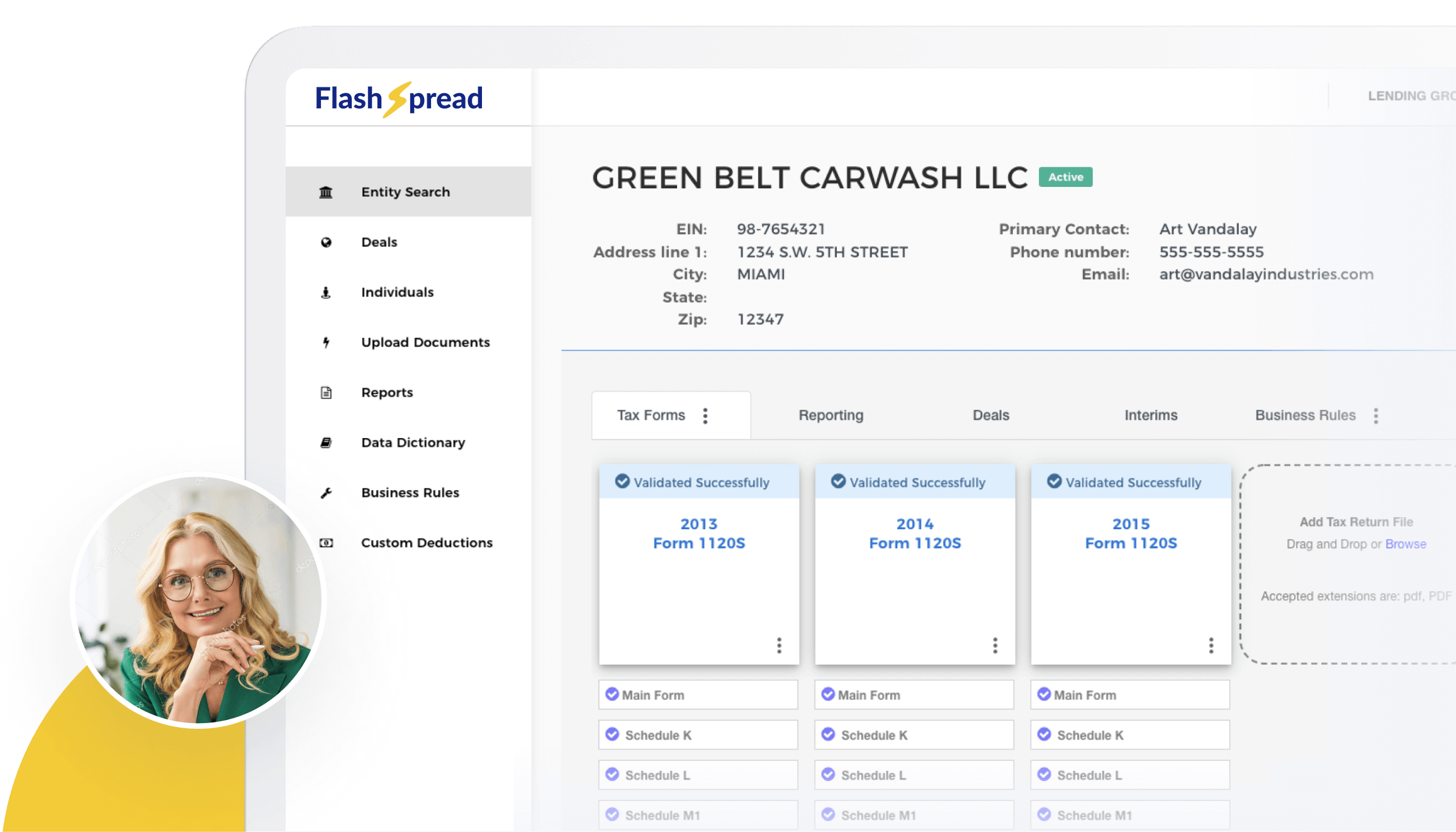
FlashSpread is built around a practical reality of commercial lending: borrower documents still arrive as PDFs, and lenders need a faster way to turn those documents into usable financial data.

Today, FlashSpread combines OCR and machine learning to automate document extraction and prepare standardized financial spreads. This foundation also positions FlashSpread to support future AI-enabled workflows that further organize, enrich, and prepare financial data for credit review.
With FlashSpread, lenders can:
- Extract financial data from tax returns, financial statements, and supporting borrower documents
- Reduce manual rekeying and spreadsheet preparation
- Organize borrower financials into standardized spreads
- Improve consistency across reviews
- Support faster underwriting preparation with cleaner data
The goal is not simply to digitize documents. It is to reduce the manual work required to prepare borrower financials for credit review. Once that data is structured, it can support more than the spread. It can help create a stronger foundation for underwriting, reporting, portfolio monitoring, and broader credit workflows.
Accuracy Matters Because Rework Is Expensive
One of the biggest hidden costs in document extraction is not the initial pass. It is the rework that happens afterward.
If extracted values are misread, mislabeled, or poorly organized, analysts still have to step in and correct the output. That means the workflow has not really been simplified. The manual work has just moved to a different point in the process.
This is why accuracy matters so much in commercial lending extraction workflows. A lender does not gain much by pulling data out of a PDF quickly if the output still requires heavy cleanup before it can be used.
The best extraction workflows reduce both manual entry and manual correction. They help teams move closer to decision-ready financial data, not just partially digitized documents.
Roundup
OCR has fundamentally improved document extraction by helping lenders digitize borrower financials and reduce manual data entry. As credit workflows continue to evolve, the focus is shifting from simply extracting information to preparing financial data that is ready for spreading, underwriting, and broader credit processes.
FlashSpread builds on today’s OCR and machine learning foundation while supporting the future direction of commercial lending. As AI capabilities continue to evolve, they have the potential to further organize, enrich, and prepare financial data for credit review, building on the strong foundation OCR has already established.
If your team is still spending hours preparing borrower financials, it may be time to rethink document extraction. See how FlashSpread helps lenders turn borrower documents into decision-ready financial data faster.