



Many commercial lending teams are operating in a reality that feels familiar: deal documents arrive through email, financial statements are saved into folders, spreadsheets are used for spreading, and credit decisions depend on a mix of manual follow-up, institutional memory, and determination.
Despite the effort involved, these teams often continue to perform well. Deals get reviewed, decisions get made, and borrowers are served. But over time, growth exposes the limits of this approach.
As deal volume rises, inboxes become harder to manage, duplicate files create confusion, manual data entry slows turnaround times, and visibility across the pipeline becomes increasingly difficult. Teams find themselves working harder to maintain the same output.
Many assume the next step must be a full Loan Origination System (LOS). For some lenders, that may be the right move. But for many lean or growing teams, there is a more practical path: improving the credit workflow itself with an AI-enabled core credit workflow
This blog outlines a step-by-step upgrade path for lenders operating without a system today, moving from inbox-driven processes to a structured, decision-ready workflow without unnecessary complexity.
Key Insights at a Glance
- Many lenders operate with email-driven credit workflows longer than expected
- Inbox-based processes create delays, duplication, and limited visibility
- The first upgrade is workflow structure, not necessarily a full LOS
- AI-enabled extraction reduces manual data entry and spreading time
- Standardized financial data improves consistency and speed
- Better workflows help teams scale without adding unnecessary overhead
Table of Contents
- Where Many Credit Teams Start: The Inbox Workflow
- Step 1: Improve Document Intake
- Step 2: Replace Manual Data Entry With AI-Enabled Extraction
- Step 3: Standardize Financial Data for Better Decisions
- Step 4: Streamline Review and Decisioning
- Q&A: Building a Workflow Without an LOS
- How FlashSpread Fits Into the Upgrade Path
- The Real Upgrade Is Workflow Confidence
- Roundup
Where Many Credit Teams Start: The Inbox Workflow
For lenders without a centralized system, the inbox often becomes the operational hub.
Borrowers, brokers, and relationship managers submit documents through email. Financial statements arrive as PDFs. Tax returns are forwarded between team members. Missing items trigger follow-up threads. Updated versions create new attachments with similar names.
This workflow can function at lower volumes, but it introduces common friction points:
- Multiple versions of the same file
- Difficulty locating the latest document
- Manual handoffs between team members
- Limited visibility into deal status
- Delays caused by missing information
The inbox was designed for communication, not credit operations. Once deal volume grows, it becomes harder to track progress and maintain consistency.
The good news is that lenders do not need to move from inbox chaos to a complex system overnight. The most effective path is often gradual modernization.

Step 1: Improve Document Intake
The first stage of a stronger workflow is creating structure around intake.
Rather than relying entirely on scattered email submissions, lenders can introduce a more consistent intake process that organizes documents as they arrive.
This may include:
- Secure upload links for borrowers or partners
- Standard naming conventions for files
- Clear checklists for required documentation
- Centralized intake queues for review
The objective is simple: reduce time spent chasing documents and determining what belongs to which deal.
When intake improves, the entire downstream workflow becomes more efficient. Analysts spend less time organizing files and more time preparing decisions.
Step 2: Replace Manual Data Entry With AI-Enabled Extraction
Once documents are received, many teams face the most time-consuming part of the process: converting borrower documents into usable financial data.
Income statements, balance sheets, and tax returns rarely arrive in the same format. Analysts often spend hours rekeying line items, validating totals, and restructuring data before credit analysis can begin.
This is where AI-enabled extraction creates immediate value.
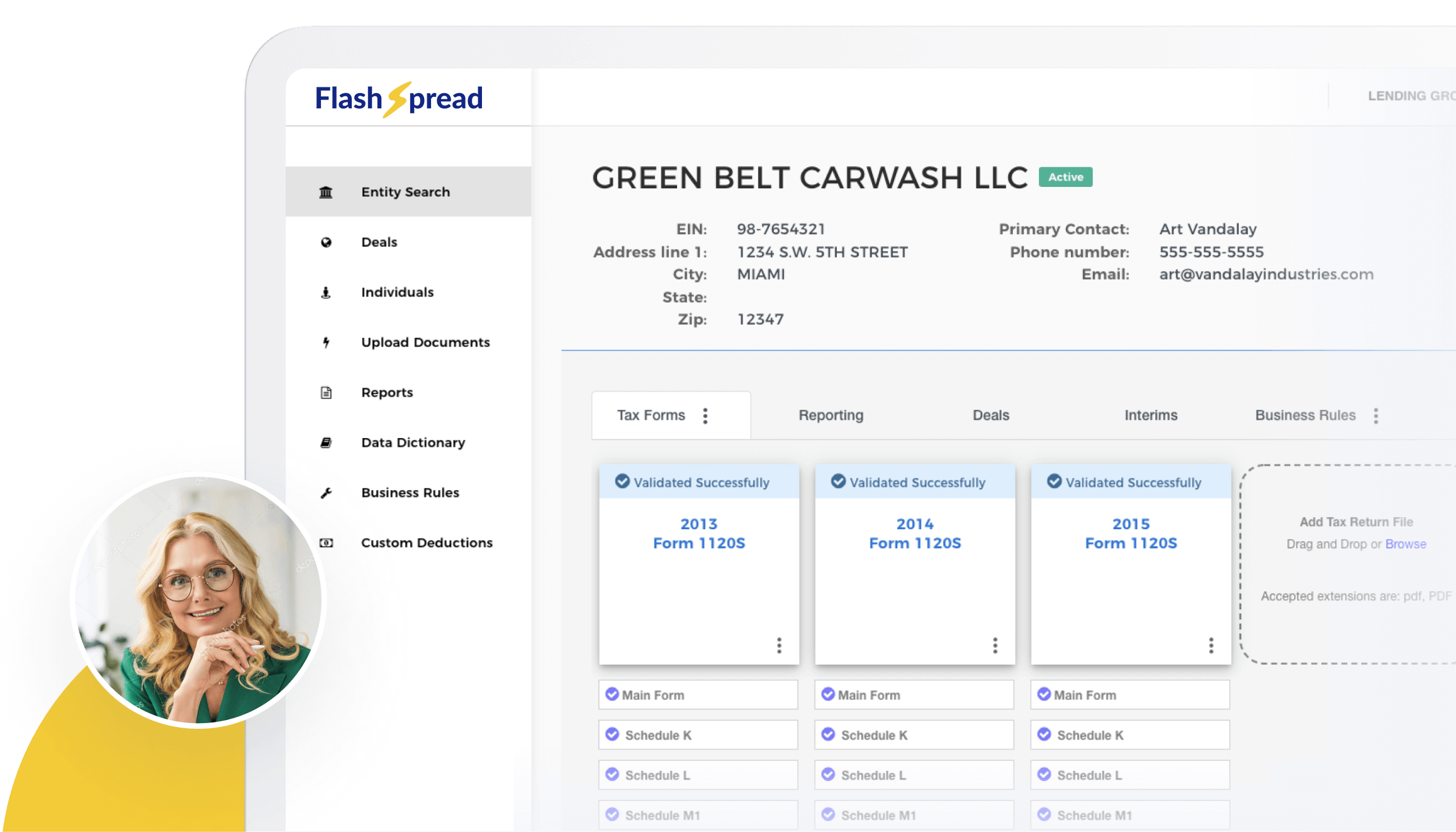
FlashSpread uses OCR and machine learning to extract and organize data from tax returns, income statements, and balance sheets. Instead of manually entering numbers into spreadsheets, teams receive structured financial data ready for review.
This can significantly reduce:
- Manual spreading time
- Transcription errors
- Delays caused by repetitive data entry
- Bottlenecks during volume spikes
For many lenders, this is the first major upgrade that materially changes capacity.
Step 3: Standardize Financial Data for Better Decisions
Speed alone is not enough. Data must also be consistent.
When one borrower’s financials are categorized differently from another’s, comparisons become harder. Ratios may be calculated inconsistently. Review cycles take longer because analysts must first interpret how data was structured.
Standardization solves this problem.
By normalizing extracted financial data into a consistent structure, lenders can:
- Compare borrowers more effectively
- Review trends across reporting periods
- Reduce interpretation friction during underwriting
- Improve confidence in ratios and metrics
This is where many manual workflows struggle. Even talented analysts may structure files differently based on experience or time pressure.
Structured workflows create consistency across the team, not just within one file.
Subscribe to BeSmartee 's Digital Mortgage Blog to receive:
- Mortgage Industry Insights
- Security & Compliance Updates
- Q&A's Featuring Mortgage & Technology Experts
Step 4: Streamline Review and Decisioning
Once intake and data preparation improve, decisioning becomes faster and more predictable.
Analysts can focus on:
- Cash flow strength
- Leverage trends
- Debt service coverage
- Industry risk factors
- Exception rationale
Instead of spending valuable time preparing data, they spend time evaluating risk.
This shift improves both speed and quality. Decisions move faster because files are cleaner. Reviews become more consistent because data is easier to interpret.
For managers, visibility also improves. It becomes easier to see:
- Which deals are waiting for review
- Where bottlenecks are forming
- How analyst capacity is being used
- Which stages create delays most often
Decisioning becomes an operational process rather than a reactive scramble.
Q&A: Building a Workflow Without an LOS
Q: Do we need to replace our current process all at once?
A. No. Many teams improve workflow in stages, beginning with intake and financial spreading before broader changes.
Q: Is this only for large lenders?
A. No. Smaller and mid-sized teams often benefit the most because manual processes create outsized strain on lean staff.
Q: Will automation reduce underwriting quality?
A. No. Automation removes repetitive preparation work. Credit decisions remain human-led.
How FlashSpread Fits Into the Upgrade Path

For lenders operating without a full LOS, FlashSpread can become the structured core of the credit workflow.
Rather than requiring a complete system overhaul, it helps modernize the most time-intensive parts of the process first.
FlashSpread supports:
Document Intake
Organize incoming borrower financials and centralize files for review.
AI-Enabled Extraction
Use OCR and machine learning to digitize and structure financial data from borrower documents.
Standardization
Normalize data across borrowers, entities, and reporting periods.
Review Readiness
Provide cleaner, decision-ready financials so analysts can move directly into underwriting.
Operational Scale
Handle higher deal volume without relying on proportional headcount growth.
For many lenders, this creates a practical middle path between spreadsheets and a full LOS.
The Real Upgrade Is Workflow Confidence
The goal of modernization is not simply to add software.
It is to create confidence that:
- Files are organized
- Data is accurate
- Reviews are consistent
- Decisions move on time
- Growth does not create chaos
A better workflow gives teams control over the process rather than forcing them to react to it.
That confidence is often more valuable than a large system rollout.
Roundup
Many lending teams continue to run credit operations through inboxes, spreadsheets, and manual handoffs. That approach can work for a time, but growth eventually exposes its limits.
The good news is that the next step does not always need to be a full LOS.
By improving document intake, introducing AI-enabled extraction, standardizing financial data, and streamlining review workflows, lenders can move from inbox chaos to decision-ready operations in practical stages.
If your team is feeling the strain of email-driven processes, it may be time to upgrade the workflow before replacing the stack. Explore how FlashSpread helps lenders turn incoming documents into structured, decision-ready financials faster and with less friction.